Research

Research on optimization, network science, and data-driven decision making for low-carbon power grids.

I am a researcher in energy systems, electrical engineering, and applied mathematics, working at the interface of optimization, network science, and data-driven decision making under uncertainty. My recent work spans stochastic unit commitment, network-constrained optimization, and unsupervised algorithms for uncovering structures in complex data.

A central theme of my recent research at the GRACE lab is how to design and operate low-carbon grids under uncertainty: integrating renewables, storage, flexible demand, and emerging resources (such as floating PV) while maintaining reliability and economic efficiency. Methodologically, I combine optimization, probabilistic modeling, and graph-based algorithms with open-source software.

Most of my work is released as open-source tools and reproducible case studies, and is disseminated through peer-reviewed publications and collaborative projects with system operators, utilities, and industry partners.

Compressed stack of a sparse network

GRACE

Optimization Power Systems Uncertainty Quantification Renewable Energy

ARPA-E funded the development of the GRACE-EMS to help solve two problems prevalent in current electrical power systems:

  • Reserve targets are sub-optimal
  • Asset risk does not play a role in their scheduling

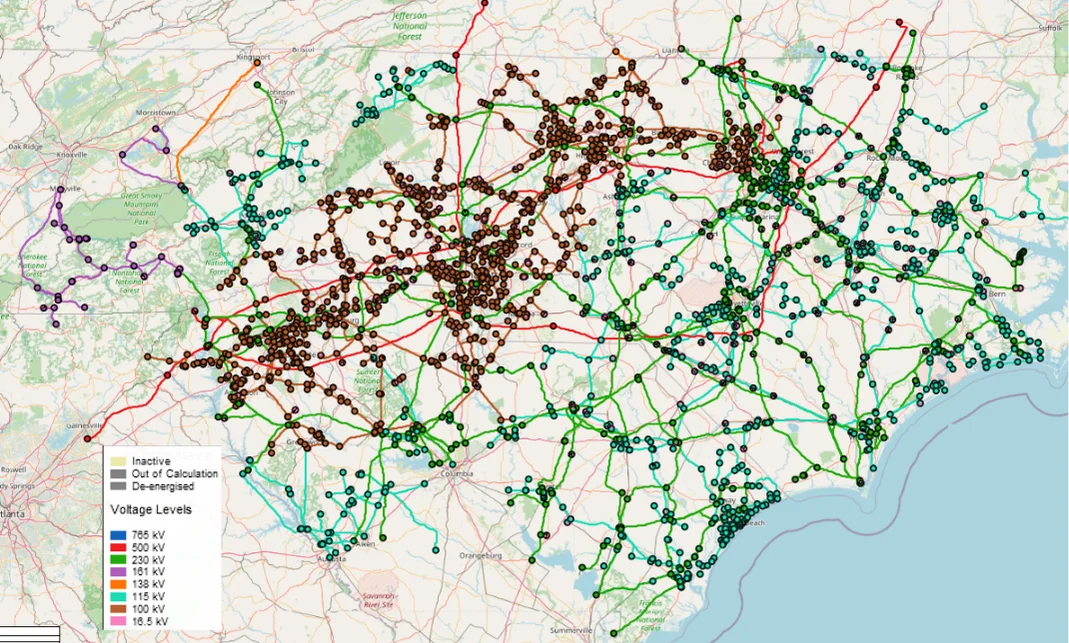
GRACE energy modeling platform

Relevant Publications

[1]
M. Hernandez, D. Floros, K. Bradbury, and D. Patino-Echeverri, “Solutions learning algorithm for the stochastic unit commitment problem.”
[2]
B. Higgins, D. Floros, M. Hernandez, Y. Alabaishi, L. Pratson, and D. Patino-Echeverri, “Estimating Headroom and Demand Flexibility requirements for fast large-load integration: A PJM case study,” Applied Energy, 2026.
Under review
[3]
W. Wang, D. Floros, A. Bhattacharya, H. Sharma, V. Adetola, and D. Patino-Echeverri, “Generation of forecast ensembles for stochastic unit commitment when data on past forecasts of weather, load, and renewables is unavailable,” 2026.
In preparation
[4]
[5]
D. Floros and D. Patino-Echeverri, “Flexible Storage Operation Policies Informed by Stochastic Unit Commitment Outcomes in Real-World Power Systems,” in International Conference on Energy Systems, Istanbul, Turkey, May 2026.
[6]
D. Floros, “Finding Solutions Within the Grid,” in Duke Today: Climate Pathfinders, Jan. 2026.
[7]
D. Floros, X. Zhang, and D. Patino-Echeverri, “Cost, reliability, and environmental benefits of a risk-adjusted stochastic unit commitment model for systems with large long-duration energy storage assets,” 2025.
[8]
D. Floros, “Enhancing electric power-grid efficiency, flexibility, and reliability via a risk-adjusted stochastic unit commitment,” in Sustainable Energy Speaker Series, Carleton, Ottawa, Canada, 2025.
[9]
M. Hernandez, D. Floros, K. Bradbury, and D. Patino-Echeverri, “Learning to solve the unit commitment problem,” 2025.
Under review
[10]
D. Floros, X. Zhang, M. Hernandez, and D. Patino-Echeverri, “Flexible Storage Commitment in Energy Management Systems under Uncertainty,” in Proceedings of the 45th IAEE international conference, in IAEE conference proceedings., 2024.
[11]
D. Floros, X. Liu, and D. Patino-Echeverri, “GRACE: A grid that is risk-aware for clean electricity,” in ARPA-E Energy Innovation Summit, Grapevine, TX, USA, 2024.
[12]
D. Floros, W. Wang, M. Hernandez, J. Kern, and D. Patino-Echeverri, “Generating Probabilistic Scenario Ensembles for Stochastic Unit Commitment,” in Proceedings of the 45th IAEE international conference, in IAEE conference proceedings., 2024.
[13]
D. Floros and D. Patino-Echeverri, “Probabilistic Forecast Generator to Enhance Uncertainty Characterization in Stochastic Unit Commitment,” in CMU Doctoral Student Participatory Workshop on Climate and Energy Decision Making, Pittsburgh, PA, USA, 2024.
[14]
D. Patino-Echeverri, D. Floros, W. Wang, M. Hernandez, J. Kern, and X. Zhang, “Grace foreseer: A probabilistic forecast generator for stochastic unit commitment,” in INFORMS annual meeting 2024, United States, Oct. 2024.
[15]
D. Floros, M. Hernandez, K. Bradbury, and D. Patino-Echeverri, “Improving the performance of risk-adjusted stochastic unit commitment for clean electricity,” in INFORMS annual meeting 2024, United States, Oct. 2024.
[16]
X. Zhang, D. Floros, M. Hernandez, and D. Patino-Echeverri, “A risk-adjusted stochastic unit commitment model to face increased uncertainty and variability from extreme weather and deeper renewables penetration,” in Proceedings of the USAEE/IAEE North American Conference, in USAEE/IAEE North American Conference Proceedings., 2023.
[17]
D. Floros, M. Hernandez, X. Zhang, and D. Patino-Echeverri, “Electric power system costs savings from a risk-adjusted stochastic unit commitment model,” in ARPA-E Energy Innovation Summit, National Harbor, MD, USA, 2023.
[18]
D. Floros and D. Patino-Echeverri, “GRACE: A grid that is risk-aware for clean electricity,” in ESIG Meteorology and Market Design for Grid Services Workshop, Denver, CO, USA, 2023.
BlueRed

Optimization Network Science High-Performance Computing Unsupervised Learning

Relevant Publications

[1]
D. Floros, N. Pitsianis, and X. Sun, “Algebraic Vertex Ordering of a Sparse Graph for Adjacency Access Locality and Graph Compression,” in IEEE High Performance Extreme Computing Conference, 2024, pp. 1–7. doi: 10.1109/HPEC62836.2024.10938496.
[2]
N. Pitsianis, D. Floros, T. Liu, and X. Sun, “Parallel Clustering with Resolution Variation,” in High Performance Extreme Computing Conference, 2023, pp. 1–8. doi: 10.1109/HPEC58863.2023.10363552.
[3]
D. Floros, N. Pitsianis, and X. Sun, “The Fiedler connection to the parametrized modularity optimization for community detection.” doi: 10.48550/arXiv.2310.14359.
Physics - Data Analysis Statistics and ProbabilityPhysics - Physics and SocietyDOIarXiv
[4]
D. Floros, N. Pitsianis, and X. Sun, “A faster method for Boolean matrix multiplication and triangle locations on a network,” 2022.
[5]
D. Floros, “Efficient analysis of local and global structures in large networks,” Aristotle University of Thessaloniki, Greece, 2022. doi: 10.12681/eadd/52905.
[6]
D. Floros*, T. Liu*, N. Pitsianis, and X. Sun, “Fast graph algorithms for superpixel segmentation,” in IEEE High Performance Extreme Computing, 2022, pp. 1–8. doi: 10.1109/HPEC55821.2022.9926359.
[7]
T. Liu, D. Floros, N. Pitsianis, and X. Sun, “Steerable Community Detection,” 2022.
[8]
D. Floros, N. Pitsianis, and X. Sun, “A systematic association of subgraph counts over a network,” 2021. arXiv:2103.10838.
Computer Science - Discrete MathematicsarXiv
[9]
T. Liu*, D. Floros*, N. Pitsianis, and X. Sun, “Digraph clustering by the BlueRed method,” in IEEE High Performance Extreme Computing, 2021, pp. 1–7. doi: 10.1109/HPEC49654.2021.9622834.
[10]
D. Floros, N. Pitsianis, and X. Sun, “Fast graphlet transform of sparse graphs,” in IEEE High Performance Extreme Computing Conference, 2020, pp. 1–8. doi: 10.1109/HPEC43674.2020.9286205.
[11]
D. Floros, T. Liu, N. Pitsianis, and X. Sun, “Using graphlet spectrograms for temporal pattern analysis of virus-research collaboration networks,” in IEEE High Performance Extreme Computing Conference, 2020, pp. 1–7. doi: 10.1109/HPEC43674.2020.9286161.
[12]
N. Pitsianis, D. Floros, A.-S. Iliopoulos, and X. Sun, “SG-t-SNE-$\Pi$: Swift neighbor embedding of sparse stochastic graphs,” Journal of Open Source Software, vol. 4, no. 39, p. 1577, 2019, doi: 10.21105/joss.01577.
[13]
N. Pitsianis, A.-S. Iliopoulos, D. Floros, and X. Sun, “Spaceland embedding of sparse stochastic graphs,” in IEEE High Performance Extreme Computing Conference, 2019. doi: 10.1109/HPEC.2019.8916505.
[14]
D. Floros*, T. Liu*, N. Pitsianis, and X. Sun, “Sparse dual of the density peaks algorithm for cluster analysis of high-dimensional data,” in IEEE High Performance Extreme Computing Conference, 2018. doi: 10.1109/HPEC.2018.8547519.
[15]
N. Pitsianis, D. Floros, A.-S. Iliopoulos, K. Mylonakis, N. Sismanis, and X. Sun, “Rapid near-neighbor interaction of high-dimensional data via hierarchical clustering,” 2017. arXiv:1709.03671.
Computer Science - Machine LearningarXiv